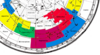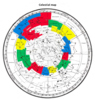
Many people perceive the Zodiac as something ephemeral and not quite true. They consider it the subject of complete harmony: 12 signs, 12 months, 12 houses, 4 elements, 3 spiritual areas, etc. At the same time, every zodiac sign have the size of 30 degrees, and it seems harmonious. Everything is fair, everything is equal. However, the Zodiac is not a figment of human imagination, despite the fact that the individual modeled it. But he did it, watching the sky! In space, as well as on Earth, phenomena don't have regular forms.
 People often ask me why natal chart calculation on my site shows incorrect data. That is, the planets, in their opinion, are not in the signs where they should be, and in general everything is different. Since the topic is raised often, and many people simply have not heard about sidereal astrology, which I use, I decided to write a special post and explain why some of my calculations do not agree with generally accepted astrology. Here you can express your opinion and ask questions.
  Please wait